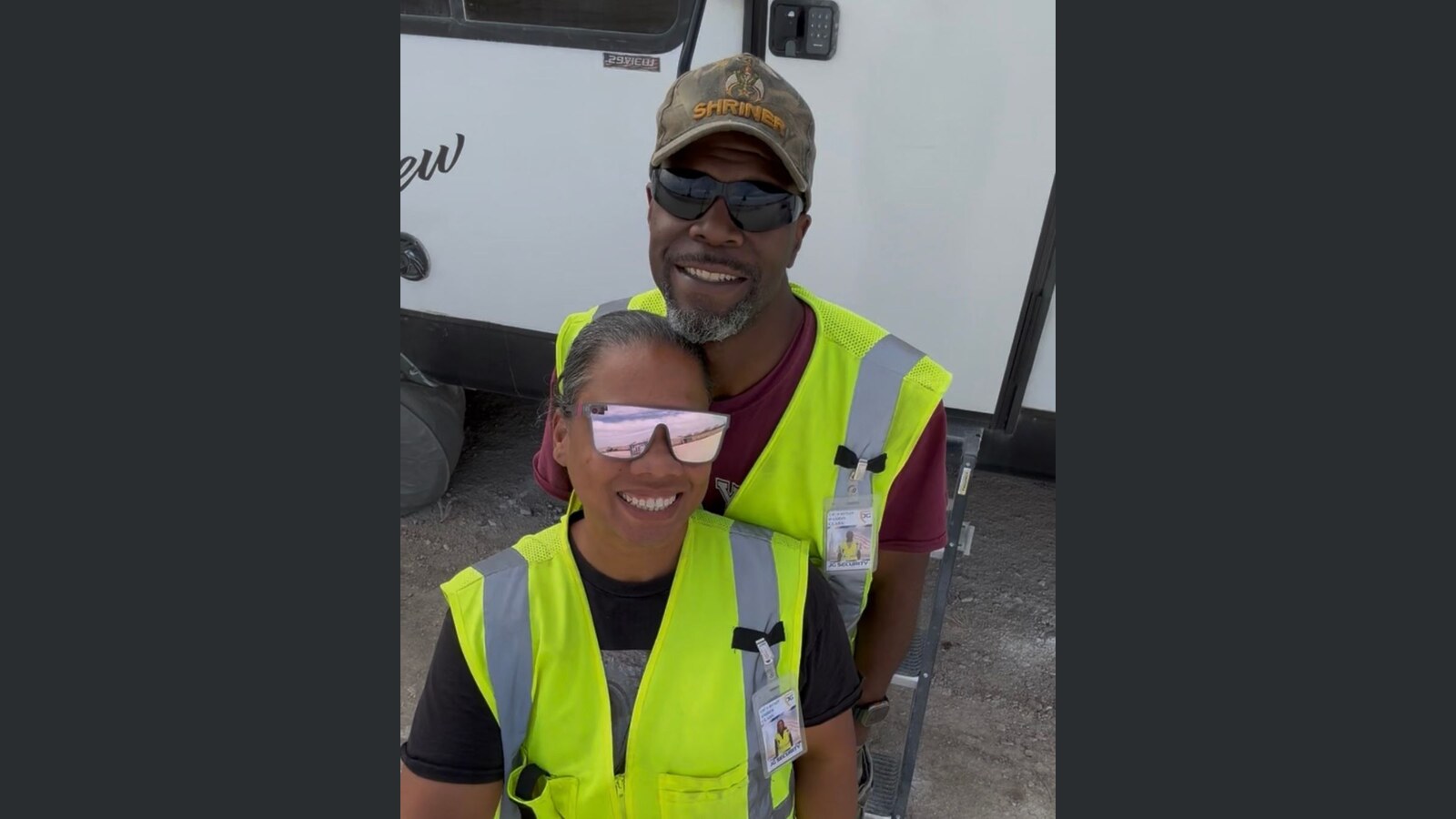
Amber and Dee Clark had to move their RV about 75 to 100 feet. A flare had been set up across the road, and a site representative worried it could damage their rig. The move was short. The catch was that vehicles still needed checking in and out while the Clarks took down their tent, disconnected the RV and set up again.
Their new spot was farther from the gate. To save some steps on the muddy ground, they got a pair of small electric scooters.
For the Air Force veterans who travel as The Veteran Nomads, that move was one memorable day on a job they’ve come to prefer. On a 24-hour gate, they park their home at the work site and take turns keeping track of who comes and goes. Their first workamping job looked quite different.
Disclosure: Amber and Dee Clark identify themselves as brand ambassadors for J&G Security. This story describes their own experiences and arrangements.
From military life to full-time RVing
The Clarks went full-time on April 23, 2023. Dee had retired from the Air Force in 2021 after 20 years. Amber served four years as an Air Force air traffic controller, then spent almost seven years driving over the road as a trucker.
Once their children were grown, they realized they were comfortable with a life that involved moving. They kept their house, bought an RV and set out.
Their first rig was a 2022 Forest River Salem Cruise Lite 361BHXL bunkhouse. Buying it online without seeing it in person turned out to be a lesson in choosing a home for full-time travel. It was not the right fit for them.
Their shakedown trip began near Chickasha, Oklahoma, south of Oklahoma City. That first night brought their first storm in an RV. Even after years behind the wheel of a semi, Amber found the experience very different.
The next morning was quiet. Standing outside together, they could see themselves doing this for a long time.
Today, they travel in a 2024 Forest River 29VIEW.
Their first assignment paid for a campsite
Their first workamping assignment was at Jellystone Park of the Gulf Coast in Elberta, Alabama, near Gulf Shores. In exchange for their campsite, Amber and Dee worked about 19 hours a week between them, roughly 9.5 hours each. They worked Fridays and Saturdays. Amber coordinated activities, while Dee helped the maintenance manager with maintenance and groundskeeping.
The position was unpaid, and they chose it deliberately. They wanted to understand their real expenses on the road before adding income to the picture. Amber also picked up a local part-time job that fit around their schedule.
By the end of the assignment, they knew what to look for next. They liked workamping, but they wanted a job that brought in money as well as a place to park.
What gate guarding looks like for the Clarks
In the work Amber and Dee describe, gate guards manage access to sites such as oil fields, energy projects and construction areas. When vehicles arrive, they check people in, record who they are and which company they represent, log arrivals and departures, and help ensure that only authorized visitors enter.
The couple has worked both 12-hour and 24-hour gates in Texas and Louisiana.
Their 12-hour assignments involved commuting from a nearby RV park and working from a guard shack or vehicle. At 24-hour gates, they live on site in their RV and divide coverage between them. They prefer the on-site arrangement: no daily commute, fewer extra miles on the truck, and their own home close by.
Friends at Gypsy Crossroads introduced them to gate guarding in 2025 as their Michigan workamping season was ending. Their path into the work included applying through a security company, taking a Texas Level II security class and getting licensed before heading to the company’s yard in Texas.
The learning continued on the job. They had to become patient with quiet stretches, keep their logs organized and manage their RV while parked far from town for weeks at a time.
How they cover a gate around the clock
Amber is the morning person. At the 24-hour gate they described, she worked from 6 a.m. to 2:30 p.m. They shared coverage from 2:30 p.m. until about 9:30 p.m., fitting in errands and time together. Dee then took the overnight shift until 6 a.m.
Night work was familiar to him after years of military shifts. They say the arrangement allowed each of them at least eight hours of sleep.
Amber estimates that hands-on gate tasks took about three to four hours a day at that site. Even during the quiet stretches, one of them had to be available whenever a vehicle arrived.
Their military experience helped with shift work and attention to detail. Amber’s air traffic control background made keeping track of movements familiar territory.
When the site allows it, they put a pop-up tent beside the gate and call it “the office.” Chairs, a television and their work supplies make it a place to spend a shift without constantly going in and out of the RV.
The setup keeps the person on duty near arriving vehicles while the other can sleep without the RV door opening and closing. It also helps keep dust outside.
What the income made possible
On the assignments Amber encountered, daily rates started around $200 for the couple. The rate depended on the gate.
At the gate she described, the company provided their RV site and hookups through a resource trailer at no cost to them. They still covered their own RV, truck, fuel, gear and food, along with the upfront class and licensing costs.
The Clarks typically choose assignments lasting two to four months, leaving other parts of the year for travel. They have used that income for more than everyday expenses.
During two assignments of about 45 days each, they also trained for their next line of work: Amber as an RV inspector and Dee as an RV technician. Amber says gate income paid for her classes, which cost almost $7,000, as well as tools, supplies, a laptop, software and setting up their LLC.
Dee’s Post-9/11 GI Bill covered his course, which they say cost about $12,000, but not his tools. Gate income helped fill that gap. They say they launched their mobile RV repair and inspection business without loans or credit cards.
“It's nice knowing we always have gate guarding to fall back on.”
Questions to ask before hitching up
Amber and Dee’s advice starts with the details of the individual gate. Before accepting an assignment, they suggest asking:
- Is this a 12-hour or 24-hour gate?
- What is the daily rate, and how and when are you paid?
- What power, water and sewer arrangements are provided?
- How far away are groceries and fuel?
- Is there a usable cell signal?
- How long is the commitment?
They also remind other RVers that they can turn down a gate whose pay does not work for them.
The Clarks see gate guarding as an option worth exploring for people with military, law enforcement or security backgrounds, as well as other full-time RVers. They do not see it as something limited to retirees.
What surprised them most was how much they liked it. They have come to prefer gate guarding over traditional workamping, particularly the 24-hour assignments that let them work from their own home base.
For their next season, the Clarks already had a plan. When they spoke with HitchPath in November 2026, they hoped to work a gate from January through April 2027, then spend the rest of the year traveling.
Follow The Veteran Nomads
Find Amber and Dee on Instagram at @the_veteran_nomads, or visit their website and links.