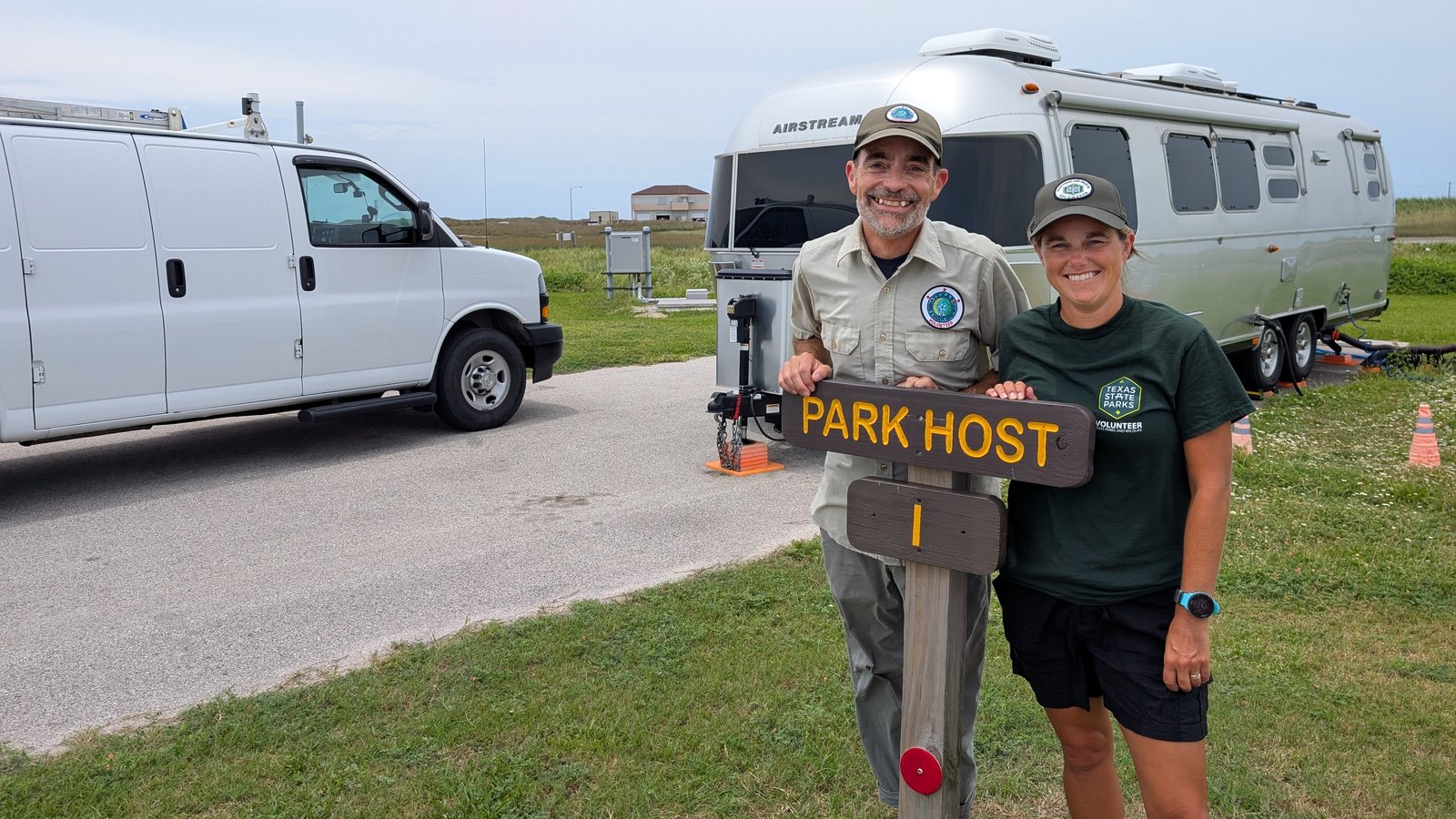
For Ari and Jessi, park hosting has become part of the rhythm of life on the road. The couple behind Trekers combines remote work with volunteer assignments, trading time and effort for a campsite and the chance to get to know a place beyond a quick visit.
In HitchPath’s first Workamper Story, they share how their travels evolved from a Roadtrek to an Airstream and a cargo van, what hosting really involves, and the questions they ask before accepting an assignment.
1. For readers just meeting Trekers, tell us a little about yourselves. How did you start traveling together, and what does your RV lifestyle look like today?
We’re Ari and Jessi, the team behind Trekers. Our journey into this lifestyle really kicked off in late 2015 with a bit of an impulse buy: a 2008 Roadtrek 190 Popular. We had been researching Class B and Class C RVs for months, but when we found that Class B in incredible shape, we took it for a test drive. So our trip to an RV dealer to test-drive different models and “see what’s available” turned into our next major purchase after we test-drove that Roadtrek! We loved traveling across the country in that rig for nearly 7 years.
Today, our setup looks a lot different. We travel and work from a 30-foot Airstream Flying Cloud Office model, which we tow with a 1-ton Chevy Express 3500 cargo van. Our lifestyle mixes Jessi’s full-time job with Ari running our digital content brand, plus exploring as much of the country as we can through hiking and visiting historical landmarks. And most of it is only possible because we also volunteer as park hosts across the U.S.
2. You spent years traveling in a Roadtrek before moving to an Airstream and a van. What drove that decision? What do you enjoy about your current setup, and is there anything you miss about traveling in the smaller rig?
The Roadtrek was incredible for getting us out the door. What we miss most about that smaller rig is the sheer simplicity of pulling into a standard parking spot, navigating tight trailheads, and camping almost anywhere without thinking twice. But as we spent more time on the road and balanced it with remote work, we needed separate work spaces and areas we didn’t have to convert twice a day. The 30-foot Airstream gives us a comfortable “home base” footprint with a dedicated workspace. But the Chevy van serves as our exploration vehicle because we’ve set it up with a bed platform, a powered Dometic cooler, and a camping toilet. So it’s the best of both worlds: a comfortable home to return to and a great rig for weekend camping excursions. And because its footprint is so much smaller than when we’re traveling with the Airstream, we can go places we couldn’t while towing.
3. How did workamping or park hosting become part of your travels? What was your first assignment, and how did you find it?
We’ve always believed life’s adventures are often found down side roads, and we wanted a way to immerse ourselves in those places instead of just passing through. Volunteering as park hosts lets us give back to the state and national parks we love while offsetting our travel costs. Our first experience was hosting at Lyndon B. Johnson State Park in Fredericksburg, Texas, and it’s still a special place we like to visit and host at when we can.
After that assignment, we found additional opportunities by checking standard volunteer listings and workamping portals, plus talking to park rangers and other hosts. We eventually built it into the rhythm of our travels, doing assignments for a few months at a time every winter and spring, and sometimes in the summer, too.
4. Take us through a typical day during a hosting assignment. What work do you do, how much time does it take, and how do you make room for your other work and activities?
The hours required vary a lot depending on the state it’s in and whether it’s a local, state, or national park. A typical morning might involve jumping in a park utility vehicle to do rounds, check campsites, empty trash, or answer camper questions. It can also mean joining the Maintenance Team as they clean bathrooms, do landscaping chores, and make repairs throughout the park as part of their daily routine.
Ari also has served as a Nature Center volunteer at a state park where he spent the day teaching people about alligators and holding baby alligators for them to see. That was unusual and quite interesting!
Ari takes on most of the volunteer hours because Jessi has a full-time remote job in public relations. Because Ari runs our YouTube channel, manages brand partnerships, and handles freelance projects, he tends to have a more flexible work schedule. But Jessi helps out as she can on weekends or during special events. One of her favorite things has been dressing up in historically accurate clothes to teach people about farming in 1918 at the historic Sauer-Beckmann Farm located within Texas’ LBJ State Park.
5. What’s something about hosting that people don’t see in the photos or job listings? A funny moment, an unexpected responsibility, or a challenging situation would be great to hear about.
People see the gorgeous sunsets and the appeal of a “free campsite,” but they don’t always see the gritty realities, like picking up beach trash, pulling cigarette butts out of fire pits, or cleaning dirty bathrooms after a particularly busy camping weekend.
But the unexpected responsibilities are often the most rewarding. For example, Ari undertook some training while serving at Enchanted Rock State Park in Texas and assisted the Search and Rescue Team with their life-saving work, which was incredibly rewarding.
6. What makes a workamping position a good fit for you? What questions do you ask about hours, duties, campsite arrangements, compensation, and days off before accepting?
A good fit balances the required hours with our need for Jessi to work a 9-to-5 job and for Ari to run the Trekers brand and do his consulting work. We always ask for extreme clarity up front to avoid burnout. What are the exact expected hours per week? Are the duties primarily maintenance, strictly campground hosting, or a combination? What cleaning duties are expected, and how late in the day do we need to be available to assist campers? We also ask specific questions about the campsite itself, including what it’s near (if it’s not in a campground), as well as whether cell service is reliable and whether there’s enough clear sky for our Starlink to work, which is non-negotiable for our remote work. Finally, we always confirm whether our days off can include at least some weekends, since that’s mostly when Jessi is available to travel for our camping getaways. Putting it in writing ensures everyone is on the same page.
7. You’ve shared experiences balancing remote work and travel. What does it take to make that work in practice? How do you handle internet access, workspace, travel days, and being together in a small space?
It takes discipline, communication, and a lot of flexibility. The Airstream is our mobile office, and redundant internet options are critical. We primarily rely on Starlink now, but we still maintain a cellular hotspot for times when too many obstacles make Starlink unreliable.
Also, when you’re living and working together in a small space, you have to respect each other’s space. Sometimes one of you needs alone time via a solo walk or run, or maybe a paddleboard trip on a lake. We really enjoy being around each other all the time, but even the best relationships benefit from some time apart. Ari does most of the travel planning, and he is always mindful of Jessi’s meeting schedule to balance when she needs to be on client calls with when we need to move the trailer between hosting assignments.
8. How does workamping affect the cost of your travels? If you’re comfortable sharing an example, what did an assignment provide, what work was expected in return, and which expenses were still yours?
It definitely helps stretch the travel budget, primarily by eliminating campground fees. Typically, an assignment provides a full-hookup campsite in exchange for around 20 to 30 hours of work per week per site. (Some places want that many hours per person, so make sure you clarify exactly how many hours are involved!) Some states also offer discounted or even free entry to other parks within their system.
However, it’s not entirely free living. We still cover all other costs. But it lets us live for months at a time in stunning places like Utah’s high desert, Wyoming’s wide-open spaces, or the Texas Hill Country, without draining our budget on nightly site fees.
9. Your van lets you take smaller trips away from the Airstream. How has that changed the way you explore? Tell us about a place or experience that this approach made possible.
This was a big game-changer for us. Having the cargo van means we have not only additional “garage” storage beyond the Airstream, but also a dedicated exploration rig ready to go at a moment’s notice. We can leave the Airstream safely set up at a home base and take the van out for dispersed camping on public lands. A great example was when we hosted at Edness Kimball Wilkins State Park in Wyoming. We often took the van to explore BLM and Forest Service dispersed camping spots or made long-distance trips to trace Oregon Trail historical sites. We never would have attempted dragging a 30-foot trailer around on a weekend to do that.
10. What has been the hardest adjustment - or a mistake that taught you something valuable? What would you do differently if you were starting today?
The hardest adjustment was learning to slow down. When you first start out, it’s easy to fall into “vacation mode,” trying to see everything, which quickly leads to travel burnout. If we were starting today, we would tell ourselves to stay longer in fewer places. A valuable mistake is one we avoided thanks to advice from friends. But we always pass it along: Don’t get caught up in the “what-ifs.” So many people get paralyzed by what could go wrong on the road. Unnecessary worrying never helps; you just have to handle the unexpected as it comes and trust your ability to problem-solve. As we have learned through experience, the true definition of RVing is, “Fixing things in beautiful places.”
11. What moment best captures why you’ve chosen this life? It could be a place, a person you met, or an ordinary day that stayed with you.
It’s often the small, quiet moments. For Ari, it could be sitting outside the Airstream in the early morning with a cup of coffee and watching a state park wake up before the crowds arrive. For Jessi, it might be going for a late-evening run after the crowds leave and the wildlife starts to reappear.
But it’s also the freedom to spend time in amazing places. Thanks to the technology provided by battery and solar power, plus satellite internet, we spent a full week in a rustic campground in Big Bend National Park and nearly a week at the Grand Canyon. There’s something surreal about being surrounded by the vast nothingness of southwest Texas, or a short drive from one of the Seven Natural Wonders of the World, while on video calls with clients!
12. What would you tell someone considering their first workamping position or an extended RV trip? What’s one practical step they can take now, and what do you wish someone had told you?
First, sit down and honestly evaluate your comfort zones, both financially and physically. Don’t wait for the “perfect” time or the “perfect” rig, because neither one exists. Your seasons of life will change, and so will the rig you travel and live in.
Second, make sure you interview the workcamping employer as much as they interview you. It needs to be a good fit for both sides.
Finally, stay flexible and willing to take risks. We’ve signed up for a few places without knowing if they would be ideal, but we reminded ourselves that even if it didn’t work out as well as we had hoped, it was only for two to three months, and then we could move on. And while we’ve had a few parks we wouldn’t necessarily put at the top of our list to return to, we haven’t had a bad experience at any of them. So, have faith!
13. What’s next for Trekers, and where can readers find you?
We’re always planning the next route and park-hosting location! Right now, we’re prepping for our next assignment, which will be two different Texas state parks from January through May. We’re also completely redesigning the Trekers website and continuing to collaborate with brands that make RV life better. Folks can find our articles, gear reviews, and travel tips at www.trekers.org. And they can hang out with us on YouTube (www.youtube.com/trekers) and on Instagram, Facebook, and TikTok (@trekersorg on all 3). If they’d like to learn more about the tips and tricks we’ve learned along our park-hosting journey, we also have an e-book available for download at www.pillar.io/trekers.
Follow Ari and Jessi at Trekers
- Website: https://trekers.org/
- YouTube: https://www.youtube.com/trekers
- Instagram: https://www.instagram.com/trekersorg/
- Facebook: https://www.facebook.com/trekersorg/
- TikTok: https://www.tiktok.com/@trekersorg
- Park-hosting e-book: https://www.pillar.io/trekers