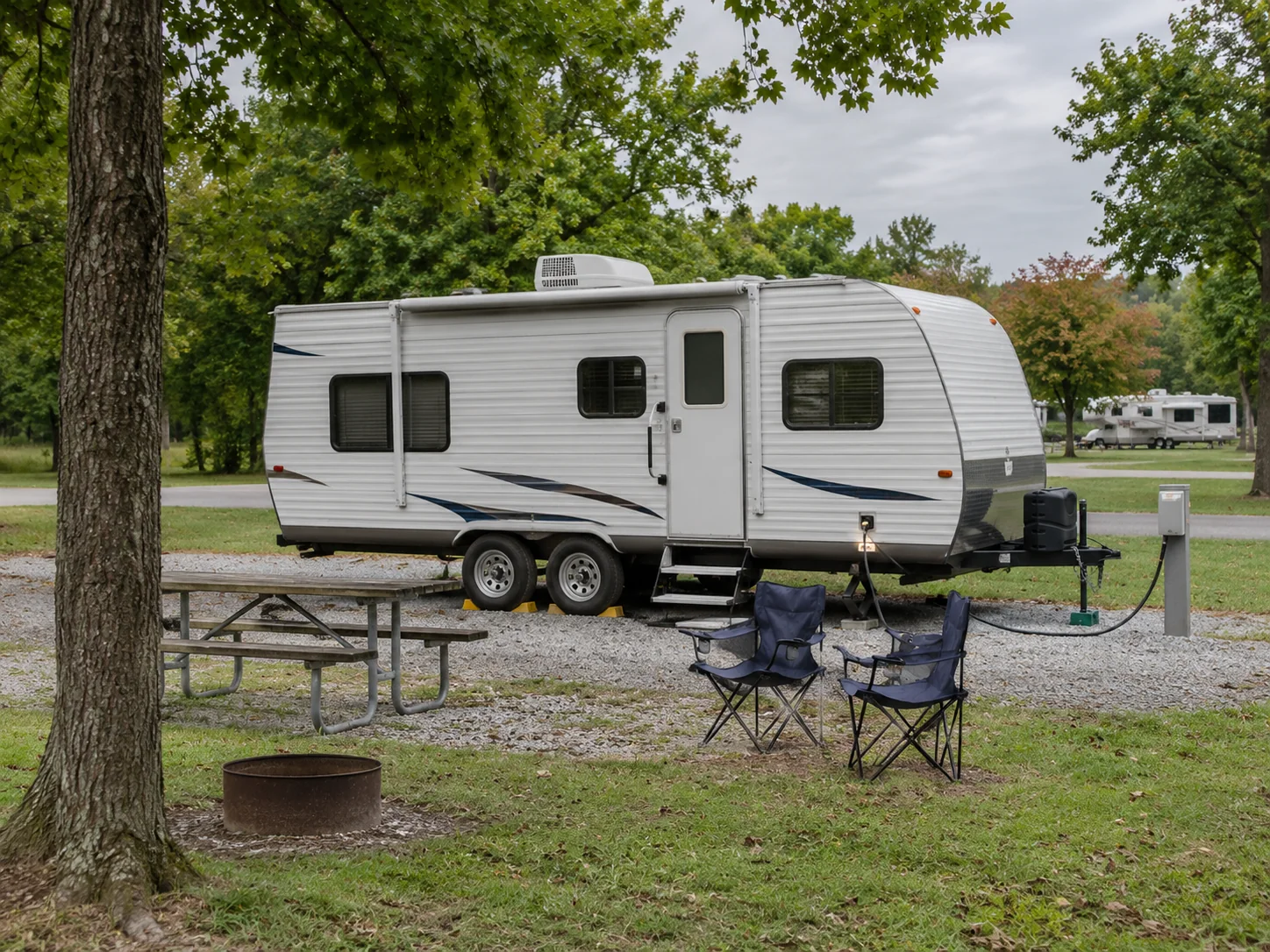
Campground prices barely moved in November, according to the latest Outdoor Hospitality Pricing Index. For workampers comparing a job with an included RV site, the news raises a practical question: how much accommodation spending would that offer actually replace?
The November 2026 report from Insider Perks recorded a 0.30% month-to-month increase across matched properties. Its RV-site average was $71.11 per night. The broader $103.57 composite included other accommodation types and should not be presented as an RV-site-only average.
Modern Campground reported on the findings on November 23. These are advertised pricing observations, not a guarantee of what a guest ultimately pays—or what a particular employer’s campsite is worth to you.
Start with the stay you would actually buy
An included campsite can reduce your travel expenses. To estimate that benefit, compare it with a realistic alternative: a site that fits your rig, in the area you need, for the dates you plan to stay.
Ask for a quote covering the whole period. A national nightly average multiplied by 30 is not a substitute for a local monthly quote. Your comparison also needs matching hookups, occupancy rules and utility arrangements.
If you would normally choose a modest park, a resort’s premium nightly rate may overstate your personal savings. The useful question is what you would otherwise spend, not the highest price someone could advertise.
A four-week example: the hours change the answer
The following numbers are fictional and illustrate a comparison method. They are not rates from the report or terms from an actual job.
Suppose a comparable campsite costs $900 for a four-week stay, including the utilities your household needs. A workamping offer includes the site, but you expect to pay $100 for electricity during those same four weeks.
Your estimated avoided accommodation spending is:
$900 − $100 = $800 over four weeks.
Now look at the work requirement:
- 20 hours per week for the household: 20 × 4 = 80 total hours. Dividing $800 by 80 gives $10 of avoided accommodation spending per required hour.
- 20 hours per week for each person in a couple: 40 × 4 = 160 total hours. Dividing $800 by 160 gives $5 of avoided accommodation spending per required hour.
The campsite has not changed. The number of hours your household must provide has doubled.
This calculation compares household costs; it does not calculate a cash hourly wage. Keep paid hours and cash earnings in a separate part of your comparison. The example covers exactly four weeks; use the actual dates and hours for your own offer.
What to ask before accepting a site-included role
A promising offer becomes easier to evaluate when both sides describe the same arrangement. Ask the employer:
- How many hours are required for the site? For couples, is that a combined requirement or a requirement for each person?
- Which hours are paid? Confirm whether cash pay applies to all work, only additional hours or a separate role.
- What does the site include? Ask about electric, water, sewer, internet and any usage caps or extra charges.
- Are there other costs or restrictions? Confirm deposits, pet and extra-person fees, rig limits and the exact campsite available.
- What happens if the assignment ends early? Ask when you would need to leave the site and whether any charges would apply.
Get the terms in writing before committing to travel. For more background, read what “site included” really means in workamping.
Price is only one part of a workable season
After calculating likely savings, consider the work itself. A convenient location, a schedule that suits your household and duties you can comfortably perform may matter as much as the campsite comparison.
Ask to see the staff site or recent photographs. Check whether it offers the space, hookups and access you need. A benefit has less practical value if you would need to pay for another arrangement to make the season work.
The November report is a useful starting point for understanding advertised prices. Your decision still depends on a local quote and a clear employment offer.
When you are ready to compare opportunities, browse jobs with an included RV site and jobs offering pay and an RV site. Look at the full package: duties, hours, cash pay, campsite costs and season dates.
Reporting note: Pricing figures come from the November 2026 Outdoor Hospitality Pricing Index. The worked example and offer-comparison guidance are HitchPath’s original illustrations.