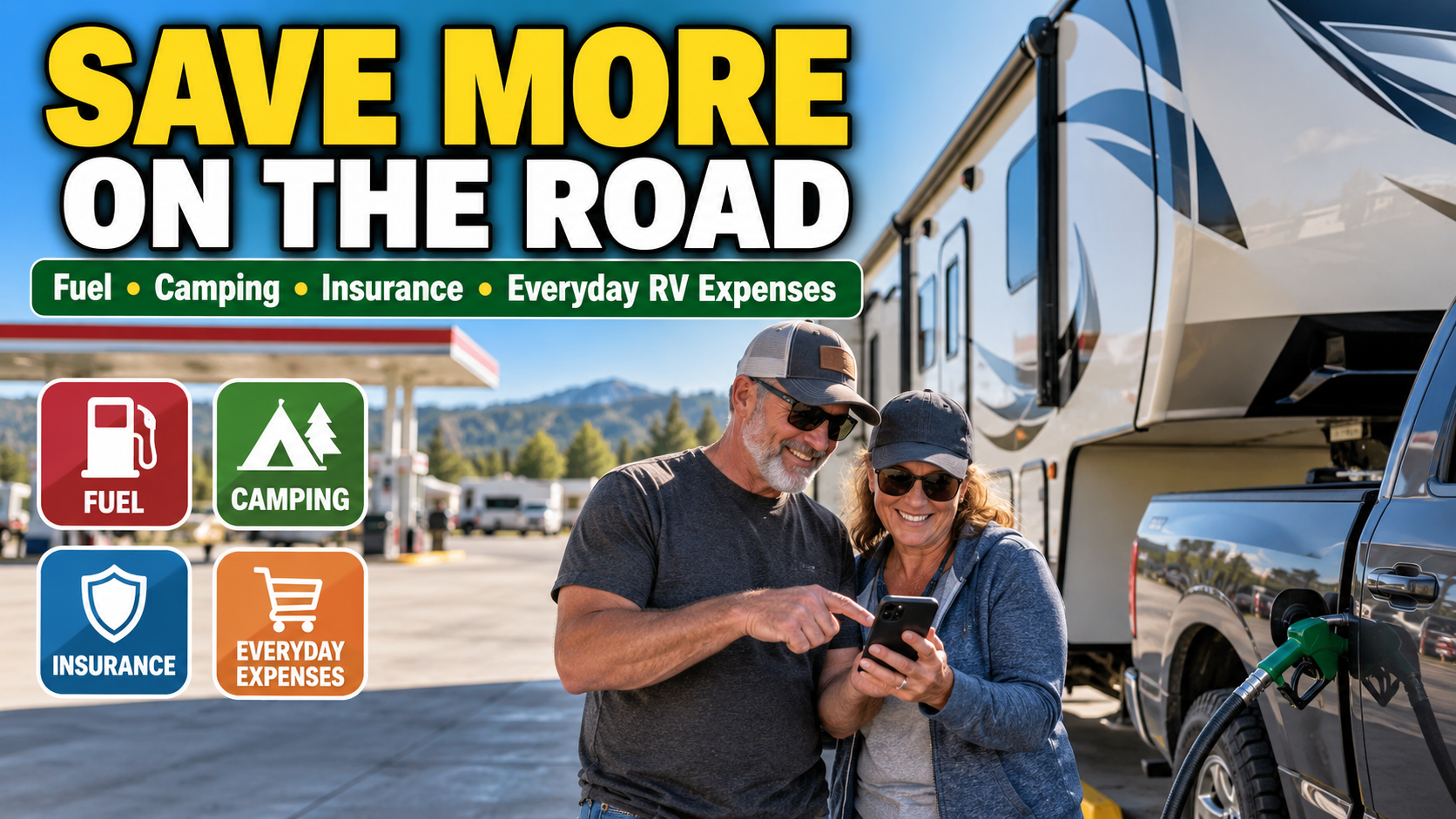
For RV travelers, the freedom of the open road isn't getting any cheaper.
Fuel, campground fees, groceries, insurance, propane and everyday travel expenses can quickly turn an affordable RV trip into a surprisingly expensive one.
But many RVers are already paying for memberships or services that include discounts they may not be using.
And one of those programs just became much more useful.
Walmart announced this month that CITGO has joined the Walmart+ fuel program, expanding the network from roughly 13,000 to more than 17,000 participating fuel locations nationwide.
That's especially relevant for RV travelers who routinely cross multiple states.
Here are nine programs and strategies worth checking before your next travel day.
- Walmart+ can save 10 cents per gallon
Walmart+ members can currently save up to 10 cents per gallon at participating Walmart, Murphy, Exxon, Mobil and eligible CITGO stations.
Members also receive access to member fuel prices at participating Sam's Club fuel centers.
The addition of CITGO in September expanded the network to more than 17,000 participating stations.
For someone towing a fifth wheel or travel trailer with a large pickup, 10 cents may not sound dramatic. But repeated 25- or 30-gallon fill-ups over a long travel season can make the membership benefit much more meaningful.
One caution: fuel programs don't always stack. For example, Walmart says its Exxon and Mobil discount cannot be combined with the Mobil loyalty-program discount.
- Your Amazon Prime membership includes a gas discount
This one is easy to miss.
Amazon Prime members can save 10 cents per gallon year-round at more than 7,500 participating bp, Amoco, ampm and Thorntons locations.
Members activate the benefit by connecting their Prime account with bp's free earnify program.
If you're already paying for Prime, this doesn't require buying another travel membership.
Amazon estimates the fuel benefit can save the average participating driver nearly $70 per year, although an RVer's actual savings will depend heavily on travel mileage, tank size and where they fuel.
- Good Sam has a Pilot Flying J fuel discount
Good Sam is another option worth comparing with the stations along your route.
Standard and Elite members can currently save 10 cents per gallon on gasoline and diesel at qualifying Pilot and Flying J locations.
The program also advertises 10 cents off propane and $2.50 off dump-station fees at participating locations.
That combination can be particularly useful for RV travelers because fuel, propane and dump services can sometimes be handled during the same stop.
- Diesel RVers should look at Open Roads
If you travel with a diesel truck or motorhome, this may be one of the biggest savings opportunities.
The Open Roads fuel program, originally developed through TSD Logistics, is available to RV owners and uses commercial truck-lane pricing.
Open Roads currently advertises typical savings of about 40 to 50 cents per gallon of diesel, although actual discounts vary by station and location.
There is one important limitation: the RV fuel card is diesel only and is designed for truck lanes with high-flow diesel nozzles.
For someone filling a large diesel tank frequently, however, even a smaller real-world discount can add up quickly.
- Check Upside before you pull into the station
Another useful strategy is simply checking competing prices before fueling.
The free Upside app offers cash-back deals at participating gas stations, restaurants and grocery stores.
Users claim an offer, make the purchase and receive cash back afterward.
Upside says rewards can sometimes be used alongside other loyalty programs, although the amount of Upside cash back may be reduced when another fuel promotion is used.
That means the lowest sign price isn't always the cheapest final price.
- Passport America can cut some campsite rates in half
Fuel gets most of the attention, but campground fees may be an even larger expense for full-time travelers.
Passport America advertises 50% discounts at more than 1,200 participating campgrounds across the United States, Canada and Mexico.
There is a catch.
Participating campgrounds establish their own restrictions. Discounts may apply only on certain days, during certain seasons or for a limited number of nights.
Passport America also says the discount generally cannot be combined with another discount.
Always check the individual campground's rules before planning your route around the savings.
- KOA Rewards takes 10% off eligible stays
Travelers who frequently stay at KOA locations may benefit from KOA Rewards.
Members currently receive 10% off the daily registration rate at participating KOA campgrounds and earn points toward future stays.
The discount generally doesn't apply to weekly, monthly or seasonal rates and cannot usually be combined with other offers.
For RVers who already choose KOA frequently, the math can be fairly straightforward: compare the annual membership price with what you would save on the stays you already expect to book.
- Don't overlook federal recreation passes
RV travelers who visit national parks and other federal recreation areas should also look at the America the Beautiful Pass.
For 2026, the annual pass costs $80 for U.S. residents and provides entrance or standard amenity access at thousands of recreation sites operated by agencies including the National Park Service, Forest Service, BLM and Army Corps of Engineers.
Travelers age 62 and older who qualify can purchase a $20 annual Senior Pass or an $80 lifetime Senior Pass.
Senior Pass holders may also receive a 50% discount on certain expanded amenity fees, including some camping fees.
Eligible travelers with a permanent disability may qualify for the Access Pass, which can also provide discounts on certain camping and expanded amenity fees.
- Call your RV insurance company and ask for every discount
This may be one of the easiest savings opportunities because it requires no change to your travel route.
RV insurers offer numerous discounts that policyholders may qualify for.
Progressive, for example, lists discounts for factors including bundling multiple policies, being the original RV owner, having a clean driving record, paying the policy in full, maintaining continuous insurance and going paperless.
Nationwide lists potential discounts for bundling, insuring multiple vehicles, completing an approved RV safety course, RV association membership, paying in full, safe driving and remaining claim-free.
Discounts and eligibility vary by state and insurer, so the better question may not be, "Can you lower my rate?"
Ask instead:
"Can you review every discount currently available on my RV policy and tell me which ones I'm missing?"
That can uncover savings without reducing coverage simply for the sake of lowering the bill.
One more Prime benefit travelers may be missing
Amazon Prime now has another benefit worth knowing about for people who spend months away from their regular doctor.
Eligible Prime members using Amazon Health AI can currently receive up to five free Direct Message Care treatments for select common conditions during 2026, subject to eligibility and state restrictions.
Prime also offers prescription savings, and Amazon says members paying without insurance may save on eligible prescriptions through its pharmacy discount program.
It's not health insurance, and eligibility varies, but it is another example of an existing membership containing a benefit travelers may already be paying for without realizing it.
The real savings strategy: Don't collect memberships — do the math
There is one trap worth avoiding.
Signing up for every RV discount membership doesn't automatically save money.
Instead, look at where you're actually traveling.
If you already have Amazon Prime, activate its fuel discount.
If Walmart, Murphy and Exxon stations dominate your route, calculate whether Walmart+ makes sense.
If you're pulling with diesel and regularly using truck stops, compare Open Roads prices.
If you spend dozens of nights in private campgrounds, Passport America, Good Sam or KOA Rewards may pay for themselves.
And if you spend your seasons working or volunteering in public lands, make sure you're using every federal pass you're eligible to receive.
The goal isn't to carry the most membership cards.
It's to make each mile of RV life cost a little less.