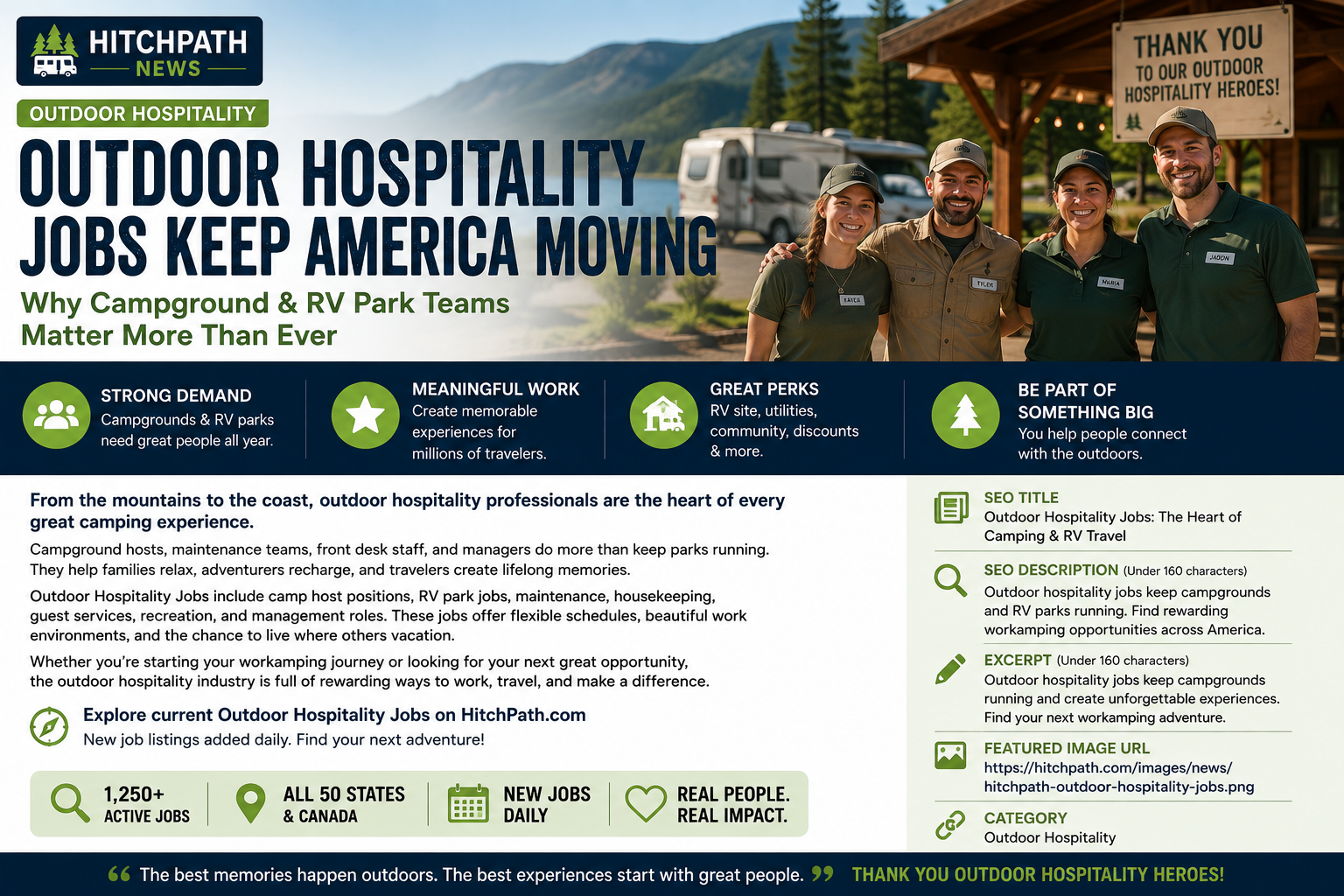
Campgrounds and RV parks are becoming more connected, experience-focused and professionally managed. Recent developments involving online reservations, business investment and employment rules show why the people working behind the scenes remain essential to outdoor travel.
During the past week, 19 Pacific Northwest properties joined a larger real-time booking network, a major Tennessee outdoor-hospitality portfolio announced a long-term investment partnership, and Kampgrounds of America received national recognition based on franchisee satisfaction. Virginia campground operators were also alerted to new rules affecting how employers advertise and fill seasonal jobs.
Together, these developments show an industry that is changing—but still depends on campground hosts, front-desk workers, maintenance teams, housekeepers and other seasonal employees to deliver the experience travelers expect.
Campgrounds Are Expanding Their Online Booking Reach
On July 30, Spot2Nite announced that 19 RV Inn Style Resorts properties in Washington and Oregon had joined its real-time campground booking marketplace.
Those properties can now appear through Spot2Nite’s website and mobile app, as well as through 13 distribution partners. Spot2Nite said the broader network includes platforms such as Camping World, Good Sam, Roadtrippers, ReserveAmerica, Outdoorsy and RVshare. The company estimates that the combined network reaches more than 69 million campers annually.
For travelers, wider distribution can make it easier to discover and reserve a campground. For campground operators, it can bring additional bookings without requiring staff to update availability separately on every platform.
However, greater online visibility can also increase the importance of accurate listings, quick communication and consistent service.
A reservation platform may help a guest find a campground, but the on-site team still determines whether the visit goes smoothly.
Technology Does Not Replace Campground Hospitality
Online booking systems can automate availability, confirmation emails and payments. They cannot answer every question or solve every problem a guest may experience after arrival.
Campground workers may still need to:
Help guests locate their assigned site Explain electrical, water and sewer connections Guide large RVs through narrow campground roads Resolve reservation or site-assignment problems Respond to maintenance concerns Clean campsites, cabins and shared facilities Provide information about local attractions Assist travelers during storms, outages or emergencies
This is where outdoor hospitality differs from a simple online transaction.
Guests may reserve a site through an app, but their lasting impression is usually shaped by the people they meet at the campground.
Investment Is Expanding Beyond Traditional RV Sites
Another July 30 announcement showed how outdoor-hospitality businesses are expanding beyond basic campsites.
Streamside RV Resorts & Campgrounds entered a long-term investment partnership involving Little Arrow Outdoor Resort, Little Arrow Base Camp RV Park, River Rat Tubing & Rafting and Burger Master in Townsend, Tennessee.
The existing local operators are expected to continue leading the businesses while Streamside provides additional resources, expertise and long-term investment. The partnership combines lodging, RV camping, outdoor recreation and food service within one destination area.
This type of combination reflects a broader direction within outdoor hospitality.
Travelers may now encounter destinations offering:
Full-hookup RV sites Cabins and glamping accommodations Food and beverage service Equipment rentals Guided activities Retail stores Events and entertainment Recreation programs Local tourism partnerships
As properties add more services, their staffing needs can become more varied.
A destination resort may need not only campground hosts and maintenance employees but also reservation agents, housekeepers, activity workers, retail employees, food-service staff and guest-experience coordinators.
Outdoor Hospitality Shows Signs of Business Resilience
On August 3, Kampgrounds of America was named one of Franchise Business Review’s Top 50 Recession-Resistant Franchises for 2026.
The recognition was based on satisfaction surveys from more than 29,000 franchisees representing over 330 brands. KOA said the results reflected franchisee views of its training, operational support, business resources, culture and long-term financial potential. KOA operates more than 500 franchised and company-owned campgrounds across North America.
That recognition is one indicator of confidence among KOA franchisees. It should not be treated as proof that every campground or outdoor-hospitality company is financially strong.
The industry still faces pressure from fuel costs, labor expenses, weather, insurance, infrastructure needs and changing traveler behavior.
New-RV manufacturing has also softened. The RV Industry Association reported 25,484 wholesale RV shipments during June 2026, down 13.1% from June 2025. Shipments during the first half of 2026 were down 14.2% compared with the same period last year. Park-model RV shipments, however, increased 25.5% during June.
New-RV shipment numbers and campground demand measure different parts of the industry. Campgrounds primarily serve the large number of RVs already on the road, so a decline in new manufacturing does not automatically mean that travelers stop camping or that campground employment disappears.
Hiring Practices Are Becoming More Transparent
Outdoor-hospitality employers must also follow changing state employment rules.
Virginia’s updated employment law requires employers to disclose a wage, salary or good-faith pay range in public and internal job postings. It also prohibits employers from seeking or relying on an applicant’s previous wage or salary history in most circumstances.
The Virginia Campground Association advised campground operators to review active employment advertisements, application forms and interview materials, particularly when hiring seasonal workers or employees for campground stores and food-service operations.
This is especially relevant to workamping arrangements, where compensation can include several different elements.
A listing should explain whether the position includes:
Hourly wages A free or discounted RV site Electricity or other utilities A stipend Commission or tips Free laundry Propane discounts Store or meal discounts A completion bonus Required hours per person or per campsite
A campsite should not be described as “free” without clearly explaining how many hours must be worked in exchange for it.
Employers should review the laws that apply in their state and obtain legal guidance when necessary.
What These Changes Mean for Workampers
Taken together, the recent booking, investment and employment developments suggest that outdoor-hospitality jobs are becoming more diverse.
Traditional campground-host duties remain important, but employers may increasingly value applicants with experience in:
Online reservation systems Customer service Hospitality and tourism Housekeeping Retail sales Food service Social media Event coordination Recreation programming Landscaping and groundskeeping Plumbing, electrical or general maintenance
Workampers should describe these skills clearly when applying.
Someone who has never officially worked at a campground may still have useful experience from a hotel, restaurant, retail store, maintenance department, tourism business or customer-service position.
Applicants should also mention their comfort with technology. Even smaller campgrounds may use online property-management systems, digital check-in tools, automated emails and mobile communication with guests.
The Human Side of Outdoor Hospitality Still Matters
Technology can make reservations faster. Investment can improve facilities. Larger business partnerships can provide marketing, training and operational resources.
But none of those improvements eliminates the need for dependable people.
A campground host welcoming a first-time RVer, a maintenance worker restoring power to a site or a front-desk employee solving a reservation mistake can determine whether a guest leaves frustrated or becomes a returning customer.
Workampers often bring an additional advantage: they understand RV travel because they live it themselves.
They know what it feels like to arrive after a long towing day. They understand why site dimensions, electrical service, road access and clear directions matter. That perspective can make them valuable members of an outdoor-hospitality team.
A Growing Range of Workamping Opportunities
The outdoor-hospitality industry is not limited to one type of campground or one type of job.
Opportunities may be found at:
Private RV parks Destination RV resorts Glamping properties Campgrounds with cabins Outdoor recreation businesses Marinas and waterfront resorts Family entertainment campgrounds Camp stores and cafés Seasonal tourism destinations
Some positions are paid hourly. Others combine wages with an RV site. Volunteer positions may provide a campsite in exchange for a defined number of service hours.
Before accepting any position, workampers should confirm the duties, compensation, schedule, campsite arrangements and utility costs in writing.
The industry may continue changing, but one thing remains constant: excellent outdoor experiences depend on the people who keep campgrounds welcoming, safe and operational.
Online platforms may secure the reservation. Outdoor-hospitality workers create the reason guests return.
Sources Modern Campground: Spot2Nite adds 19 RV Inn Style Resorts properties to its real-time booking network. Woodall’s Campground Magazine: Streamside announces its long-term Tennessee outdoor-hospitality partnership. Modern Campground: KOA receives 2026 recession-resistant franchise recognition. RV Industry Association: June 2026 wholesale RV shipment report. Code of Virginia and Virginia Campground Association reporting on updated hiring requirements.