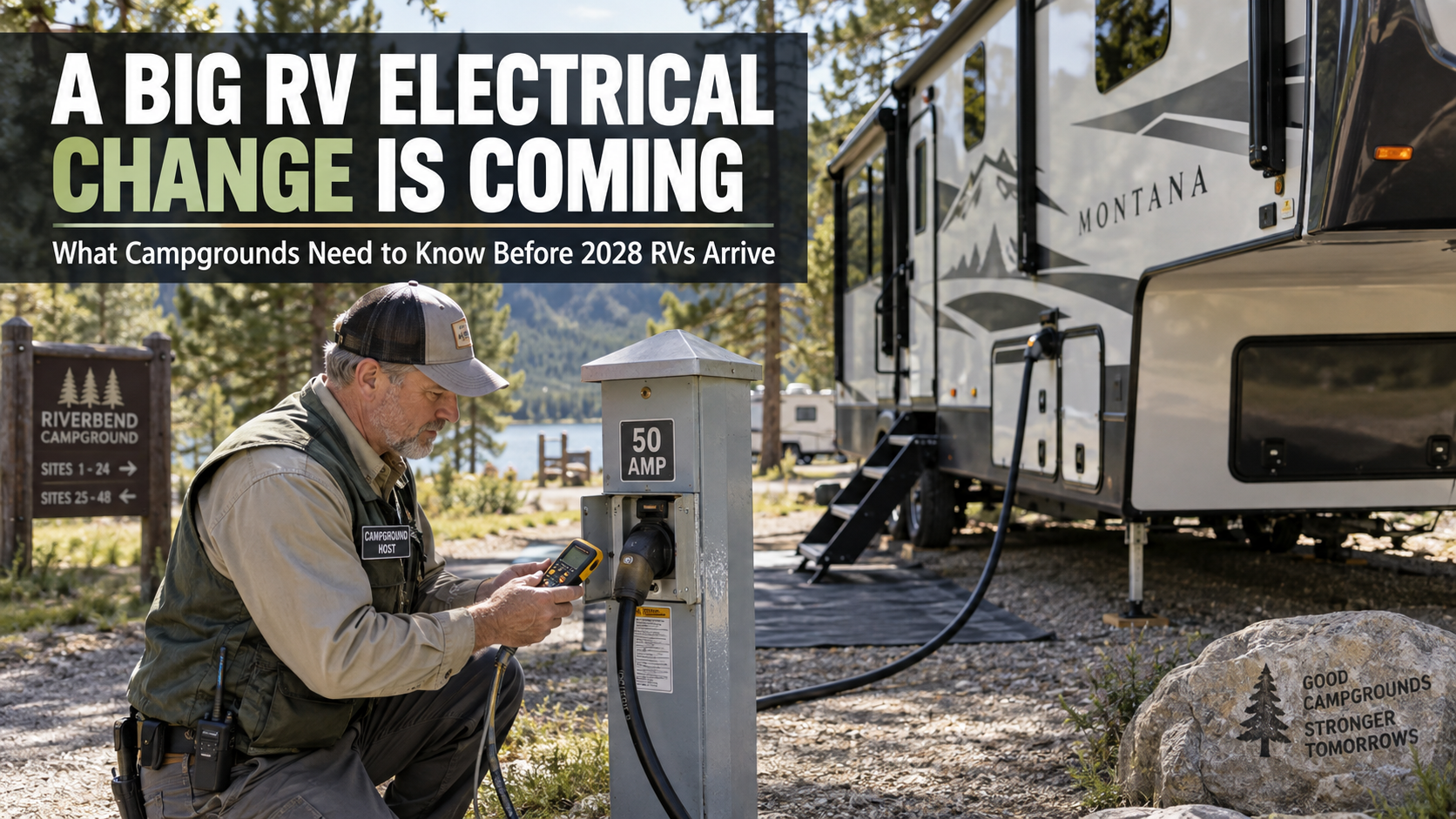
A Major RV Electrical Change Is Coming — Campgrounds Need to Prepare Now
A significant electrical safety change is headed toward the RV industry, and campground operators may begin feeling its effects as early as next year.
Beginning with model-year 2028 production, new RVs equipped with 30-amp or 50-amp electrical service will be required to include a Grounding Monitor Interrupter, commonly called a GMI.
The change might sound highly technical, but its effect at the campground could be very simple: an arriving RV plugs into a pedestal, detects a grounding problem and refuses to accept power.
The RV Industry Association is now urging campgrounds to prepare before GMI-equipped RVs begin showing up at campsites.
What does a GMI actually do?
A Grounding Monitor Interrupter is designed to make sure an RV has a safe ground connection.
Before electrical current is allowed into the RV, the GMI checks the receptacle or campground pedestal for a proper grounding connection. It continues monitoring that connection while the RV is plugged in.
If the ground connection is lost, compromised or otherwise fails the system's requirements, the GMI can disconnect power to the RV.
One of the safety issues the system is intended to address is commonly called "hot skin."
That can occur when an electrical problem causes the metal frame or exterior components of an RV to become energized. Proper grounding provides a path for electrical faults and is an important part of protecting people around the RV.
The GMI requirement is contained within Article 551 of the National Electrical Code. RVIA says all new RVs using 30-amp or 50-amp service will eventually fall under the requirement.
When does the change happen?
There are two dates worth understanding.
RVIA's Board of Directors approved January 1, 2027 as the effective date for the GMI requirement.
Mandatory enforcement then begins with each manufacturer's respective model-year 2028 production. Because RV manufacturers commonly begin producing the next model year well before the calendar changes, GMI-equipped 2028 RVs could begin appearing at dealerships and campgrounds during 2027.
That gives campground operators some time to prepare, but not as much as the "2028" name might suggest.
Why this matters for campgrounds
For many parks, nothing noticeable may happen.
A properly wired and grounded campground electrical system should be able to serve these RVs normally.
The concern is with pedestals or campground electrical systems that have grounding problems that have gone unnoticed.
According to RVIA, a pedestal that seems to work with today's RVs may not necessarily work with a GMI-equipped RV. The new device actively checks grounding conditions before allowing power to the unit.
That could create a new situation at the campground office.
A guest may plug in, get no power and assume something is wrong with the RV. Campground staff could assume the RV's electrical system is defective.
In reality, the GMI may simply be doing exactly what it was designed to do.
RVIA has created a campground task force
The issue has become significant enough that the RV Industry Association announced a Grounding Monitor Interrupter Task Force in September.
The group includes RV manufacturers, suppliers, campground operators, dealers, electrical experts and national and state campground organizations.
Its purpose is to help the industry understand GMIs, prepare facilities and develop procedures for situations in which a GMI shuts power off to an RV.
One of the task force's first recommendations is straightforward: test campground electrical systems before GMI-equipped RVs begin arriving.
RVIA says campgrounds should make sure there is good ground continuity between individual campsite pedestals and the facility's electrical service. Electrical work should be performed in accordance with applicable codes and by qualified professionals.
What this could mean for workampers
This is also worth watching for campground hosts, maintenance workers and other workampers.
Campground staff are often the first people a guest contacts when a campsite has an electrical problem.
As newer RVs enter the campground, workers may begin hearing a new version of a familiar complaint:
"My RV won't take power from the pedestal."
Knowing that GMI-equipped RVs exist could help staff recognize that the problem might involve the pedestal's ground rather than simply a tripped breaker or malfunction inside the RV.
Parks may eventually add GMI awareness to maintenance procedures, electrical inspections and employee training.
For workampers who regularly help guests troubleshoot campsite problems, understanding the change ahead of time could become surprisingly useful.
RVers should understand the change too
Owners of future RVs should also know what their GMI is telling them.
If a GMI-equipped RV refuses campground power, bypassing or defeating a safety system isn't the answer. The condition should be investigated.
Likewise, a campground should not automatically assume that a new RV is defective simply because another RV previously worked on the same pedestal.
The goal of the new system is to identify grounding problems that otherwise might not be obvious.
A campground issue worth addressing before 2027
This won't change overnight, and millions of existing RVs without GMIs will remain on the road for years.
But the transition is now moving from an industry standards discussion to something campground owners could soon encounter at actual campsites.
With model-year 2028 RV production beginning during 2027, parks have an opportunity to inspect electrical infrastructure, educate employees and correct grounding problems before guests begin arriving with equipment capable of detecting them.
For campground operators, it's another reason preventive electrical maintenance matters.
And for workampers, it's one more change in the RV world that's worth knowing before someone knocks on the host-site door saying, "My camper won't turn on."